The short answer: Every U.S. generation is moving into a new life stage at the same time. Census counts 64.6 million Americans 65 and older, up 16.2% since 2020, while the number of children fell. Line up your product, pack and claims with the life stage your buyer is in now, not with a generation label, and start with the customer data you already have.
Most brands we meet describe their buyer the way they did at launch. “Millennial moms.” “Gen Z wellness.” “Boomers who trust the classics.” The trouble is that the people behind those labels kept aging. The millennial mom from your 2018 deck may now be shopping for a teenager. The boomer who loved the classic is now reading the label with reading glasses.
The U.S. population is shifting under every brand at once. If your product, pack and message still fit the stage your buyer was in five years ago, you are slowly drifting away from them without changing a thing.
What the new numbers say
On June 25, 2026, the U.S. Census Bureau released its Vintage 2025 population estimates by age. A few lines matter for anyone who sells a consumer product:
- The country keeps getting older. The U.S. median age was 39.4 in July 2025, up from 39.2 a year earlier and 38.6 in April 2020.
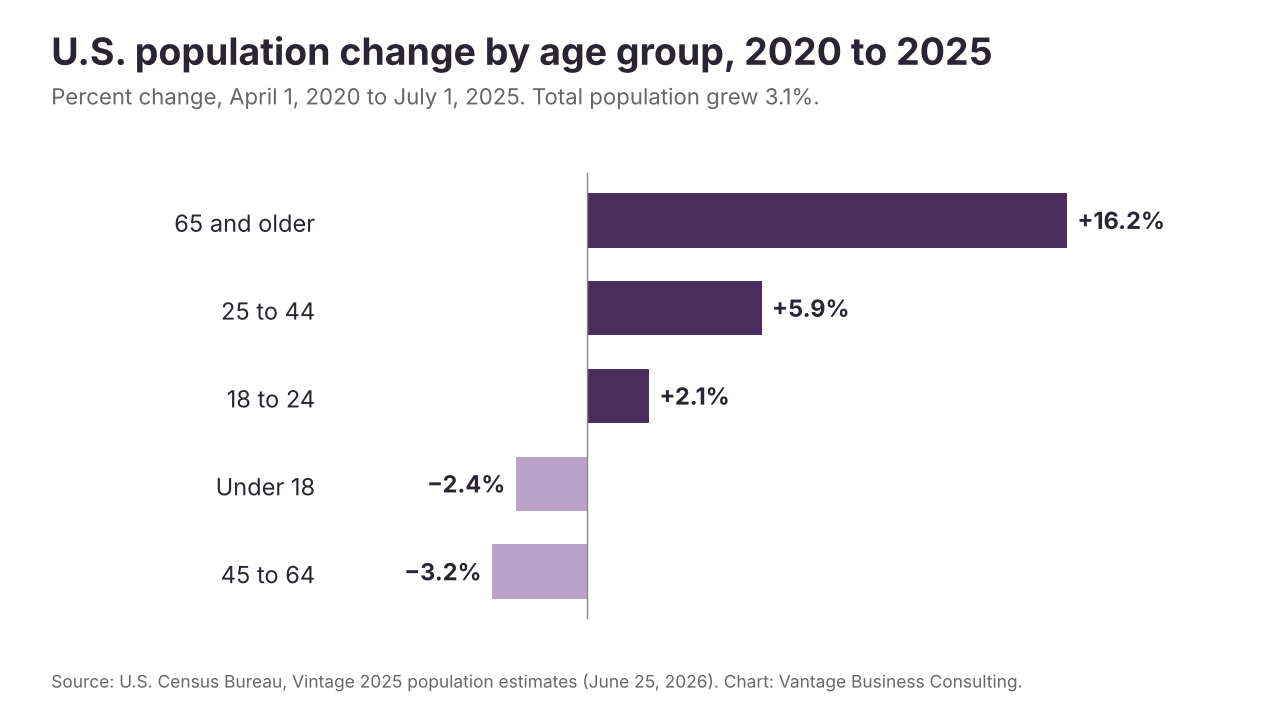
- The 65 and older group is the growth engine. It rose from about 55.6 million in April 2020 to about 64.6 million in July 2025, up 16.2%, while the total population grew 3.1%.
- There are fewer kids. The under 18 population fell 2.4% over the same period, to about 72.0 million.
- The middle is split. Ages 25 to 44 grew 5.9%. Ages 45 to 64 fell 3.2%, as more boomers aged past 65.
The year before, the Census Bureau reported that older adults outnumbered children in 11 states and almost 45% of U.S. counties in 2024, up from three states in 2020. The 65 and older share of the population rose from 12.4% in 2004 to 18.0% in 2024, while the share of children fell from 25.0% to 21.5%.
The pipeline of kids is not refilling it. The CDC counted 3,606,400 U.S. births in 2025, down 1% from 2024 (released April 9, 2026), with the general fertility rate down slightly to 53.1 births per 1,000 women ages 15 to 44.
Where each generation sits right now
Generation labels are shorthand, and they are blunt. We use them here only to find the life stage, because the stage is what changes the shopping list. Birth years follow Pew Research Center’s definitions; ages are as of 2026.
- Gen Alpha (born about 2013 on, 13 and under). Kids. Parents pay, but kids ask, point and pick. Fewer births mean kid-focused categories are fighting over a slowly shrinking base, so growth comes from share, not from more kids.
- Gen Z (born 1997 to 2012, ages 14 to 29). From school to first paychecks and first apartments. This is when people buy a category for the first time on their own: the first cleaner, the first candle, the first multivitamin they picked themselves. Entry price and trial size matter here. We covered how this group shops the aisle in Why Gen Z Is Going Back to Retail.
- Millennials (born 1981 to 1996, ages 30 to 45). The heart of the growing 25 to 44 group. For many, these are the years of young kids, busy weeknights and running a full household. Value sizes, convenience and products that work for the whole family earn their place.
- Gen X (born 1965 to 1980, ages 46 to 61). For many, kids are leaving or have left home, some are helping aging parents, and their own health and upkeep start to get attention. Smaller household sizes and “for me” purchases show up again.
- Baby boomers (born 1946 to 1964, ages 62 to 80). All of them are now past 60, and they are why the 65 and older group grew so fast. Retirement, fixed incomes for some, grandkids, and a pack that has to be easy to read and easy to open.
None of these is a personality type. A 35-year-old without kids and a 35-year-old with three are in different stages, and they buy differently. That is the point: the stage tells you more than the label.
Why this is a product problem, not just a marketing problem
When a buyer changes stage, the job they hire your product to do changes. The household gets bigger or smaller. The budget tightens or loosens. Eyesight, grip strength and patience for a fussy closure change too.
A brand can miss this in three ways:
- The pack ages out. Small type, a low-contrast label or a hard-to-open cap quietly costs you older buyers who never complain. They just stop buying.
- The size ladder is stuck in one stage. A brand built on a family size has nothing for the empty nester or the first-apartment buyer. A brand built on single serve has nothing for the family stocking up.
- The message talks to who the buyer used to be. Copy written for a new parent does not land with that same person ten years later.
Our founder ran mature brands at Dial, launched White Barn Candle Co. and Wallflowers at Bath & Body Works, and later bought and grew Pert Plus and Sure. Our view from that work: a mature brand grows when it serves the buyer it has now, not the buyer it had at launch. We wrote about the bigger version of that choice in Rebrand, Refresh, or Milk It?

The stage alignment plan you can run this month
Cheapest and most important steps first. Most of this is data you already own and a few afternoons.
- Find out who buys today (one afternoon, free). Pull the last 12 months of what you already have: DTC customer data, Amazon or retailer shopper insights, review text, customer service emails. Sort buyers into rough age bands and life stages. Then compare it to the buyer in your brand deck. The gap is your starting point.
- Map each SKU to a stage (one afternoon, free). For every item, write one line: which life stage buys it, and what moment triggered the purchase (first apartment, new baby, kids gone, retirement). Items you cannot map are usually the slow movers.
- Audit the pack for the stage (one week, low cost). Print your label at actual size and hand it to someone in your core buyer’s stage. Can they read the benefit and the directions without squinting? Can they open it with one hand, or with stiff fingers? Is the count right for their household? Fix type size, contrast and closure before you touch the formula.
- Check where your buyers live (two hours, free). Age is not spread evenly. Census puts Maine’s median age at 44.9 and Utah’s at 32.6. Compare your store list and DTC ship-to data to where your stage actually lives, and use it in the next retailer conversation.
- Fill one gap in the size and price ladder (one quarter, moderate cost). If your buyers skew one way, add the one size the next stage needs: a trial or entry size for first-time buyers, a value size for families, a smaller pack for one- and two-person households. One size, not five.
- Test one stage message before you change the product (two to four weeks, low cost). Run two versions of the same ad or product page copy, one written for the stage you think you serve and one for the stage the data says you serve. Let the click-through and conversion decide. Any new claim still has to be one you can support.
- Only then decide on a new product (next planning cycle). If the data shows a stage you cannot serve with pack, size or message, that is a real line extension case. Put it through the shopper benefit test in Line Extensions Start With the Shopper first.
What not to do
- Do not market to a label. “Gen Z” is fifteen birth years wide. A 15-year-old and a 29-year-old are in different stages.
- Do not chase the biggest number blindly. The 65 and older group is growing fastest, but if your product does not do a job for that stage, a new ad will not fix it.
- Do not talk down to anyone. Older buyers want a pack that works, not one that says “senior” on it. Younger buyers notice when a brand tries too hard.
- Do not change the formula first. Pack, size and message are cheaper and faster to fix, and they are usually the real gap.
Next step
A buyer who changes stage is a buyer you can keep, if the product changes with them. Our pillar post, Product-Market Fit Isn’t a Feeling, shows how to prove fit with numbers rather than a hunch. At Vantage Business Consulting, we help consumer brands find who is really buying, line up the pack, size ladder and message to that buyer’s stage, and decide which new items are worth the shelf. If 2027 includes a refresh, a relaunch or a new retailer, start with the free Launch Scorecard below.