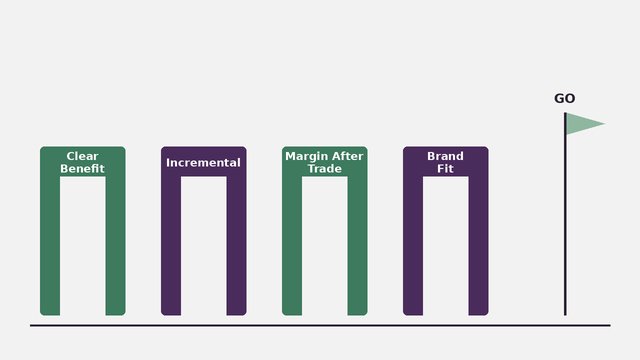
The short answer: A limited edition earns its place when it brings in new shoppers or a bigger basket, sells through at full price, and leaves nothing behind in the stockroom. Most seasonal SKUs lose their margin on the back end: minimum orders, markdowns, leftovers, and sales they take from your core items. Run the math to the last unit, including the ones you will not sell, before you place the order.
Every brand wants a holiday item. The buyer asks what you have for the season, the team loves the design, and a limited edition feels like free news. It goes on the calendar before anyone has done the math on what happens in January.
That is the problem with most seasonal SKUs. The upside shows up in week one. The cost shows up after the season ends, in markdowns, leftover cartons, and core sales that quietly went missing. This post covers why the question matters right now, what a limited edition is supposed to do, where the margin actually goes, and a six step test you can run this month before you commit to the next one.
Why this matters this holiday
Shoppers are still spending, but they are spending carefully. The National Retail Federation forecast on Oct. 15, 2026 that November and December retail sales will grow 4.2% to about $1.013 trillion. NRF’s chief economist also said inflation, rising gas prices, and pressure on household budgets will hit income groups differently.
Deloitte’s 2026 holiday survey, published the same day, found 79% of shoppers believe higher prices are coming, and that 38% are “value seekers” who use five or more cost saving behaviors, such as shopping promotions and turning to store brands and other cheaper options. A seasonal item at a full premium price has to win over a careful shopper, not an impulse buyer.
Big brands are leaning on newness to get through it. In its third quarter results, Hershey reported net price up 11% and organic volume down about 7%, and executives said the company is counting on new items and more marketing “in the season and into 2027,” using promotions and pack sizes rather than price cuts, Reuters reported on Oct. 30. A company that size can absorb a seasonal miss. A $5 million brand often cannot.
What a limited edition is supposed to do
A seasonal SKU has three legitimate jobs. If it does none of them, it is decoration.
- Bring in a new shopper. A gift set or holiday scent can reach someone buying for another person, who may never have tried your core item.
- Grow the basket. A current customer buys the limited item in addition to the usual one, not instead of it.
- Give the buyer and the shopper a reason to look again. Newness can earn a display, a feature, or a spot in a holiday set that your everyday items would not get.
Our founder lived this at scale in home fragrance at Bath & Body Works, where the everyday line ran all year and a new seasonal collection followed every four to six weeks, from Spring to Back to School to two holiday drops. In one later year that team delivered 350 new items across Seasonal and Everyday, a story he told in Making Order Out of Chaos. A machine like that only works with a forecasting, sourcing, and markdown discipline most small brands do not have yet.
The shopper test still comes first. As we wrote in Line Extensions Start With the Shopper, a new item has to give the shopper something your current line does not. A seasonal SKU adds a second test: it has to pay for itself in a window that closes on a fixed date.

Where the margin goes
A limited edition looks great in the planning deck because the deck assumes every unit sells at full price. Here is where that assumption breaks.
- Minimum orders. Custom jars, cartons, tins, and labels often come with minimum order quantities well above what a small brand would forecast. You end up ordering to the minimum, not to the demand.
- One shot at the forecast. Seasonal items rarely get a reorder in time. Order too few and you leave sales on the table. Order too many and you own the leftovers.
- Markdowns. A holiday item that does not sell by late December is worth much less on Dec. 26. Retailers often ask the brand to help fund that markdown. We covered how that works account by account in Retailer Margin Requirements and Markdown Strategy.
- Cannibalization. If your loyal customer buys the holiday scent instead of the everyday one, you did not add a sale. You swapped one, and often at a lower margin.
- One-time costs. Design, artwork, plates, samples, and photography are spent once and spread over one short run.
- Attention. The same small team that should be fixing velocity on the hero item spends October on a product that will be gone in January. We made that case in Your Hero SKU Is Lying to You.
Here is how fast it adds up. This is an illustration with round numbers, not a real brand.
That is still a positive number, and in some years it is worth it. But it is a different decision at $6,500 than at $30,000, and it turns negative fast if sell-through slips or the minimum goes up.
The seasonal SKU test: six steps you can run this month
Here is the order we use, cheapest first.
- Pull last season’s numbers (free, one afternoon): for every seasonal item you ran last year, write down units ordered, units sold at full price, units marked down, units left, and what your core items did in the same weeks. If you cannot fill in the table, that is your first fix.
- Name the job (free): write one sentence on which of the three jobs this item does: new shopper, bigger basket, or a reason for the buyer to give you space. If the honest answer is “the team wanted something new,” stop here.
- Set a full-price sell-through target and an exit plan before you order (free): decide what share must sell at full price by a set date, and what happens to the rest: a bundle, a gift with purchase, a staff sale, or a donation. Agree on markdown funding with each retailer in writing before the purchase order, not after.
- Build seasonal from your core (low cost): a new sleeve, label, or color on your existing jar, bottle, or formula keeps minimum orders and one-time costs down. New components are where the minimums bite.
- Order to the base case, not the dream (low cost): plan the run on your realistic sell-through, then decide whether the minimum is worth it. If you must order to a minimum far above demand, the item fails the test. Our guide on building a forecast buyers and lenders believe walks through base, low, and high cases.
- Read the result honestly in January (moderate effort): measure total brand sales in those weeks, not just the seasonal item. If core sales dropped while the limited edition sold, count the swap. Keep the items that added, cut the ones that only traded places.
When to say no to a seasonal SKU
Some years the right holiday item is no holiday item. If your hero SKU is still fighting for velocity in its first accounts, a seasonal twin splits the shopper’s attention and your team’s. If cash is tight, a run of inventory that must sell in eight weeks is the riskiest place to put it. And if last year’s leftovers are still in the warehouse, you already have your answer.
Saying no does not mean going quiet for the season. A holiday sleeve on your core item, a simple two-pack, or a display built around the product you already sell can earn the same buyer attention with far less risk. You can still get holiday news without paying for it in January.
Next step
A limited edition is one decision inside a bigger one: what your assortment should look like a year from now. Our guide Your Hero SKU Is Lying to You covers how to keep the core strong while you add. At Vantage Business Consulting, we help consumer brands decide what to launch, what to cut, and how to plan the season so the margin survives it. If you are mapping your 2027 calendar, the free Launch Scorecard below shows where your gaps are in about three minutes.