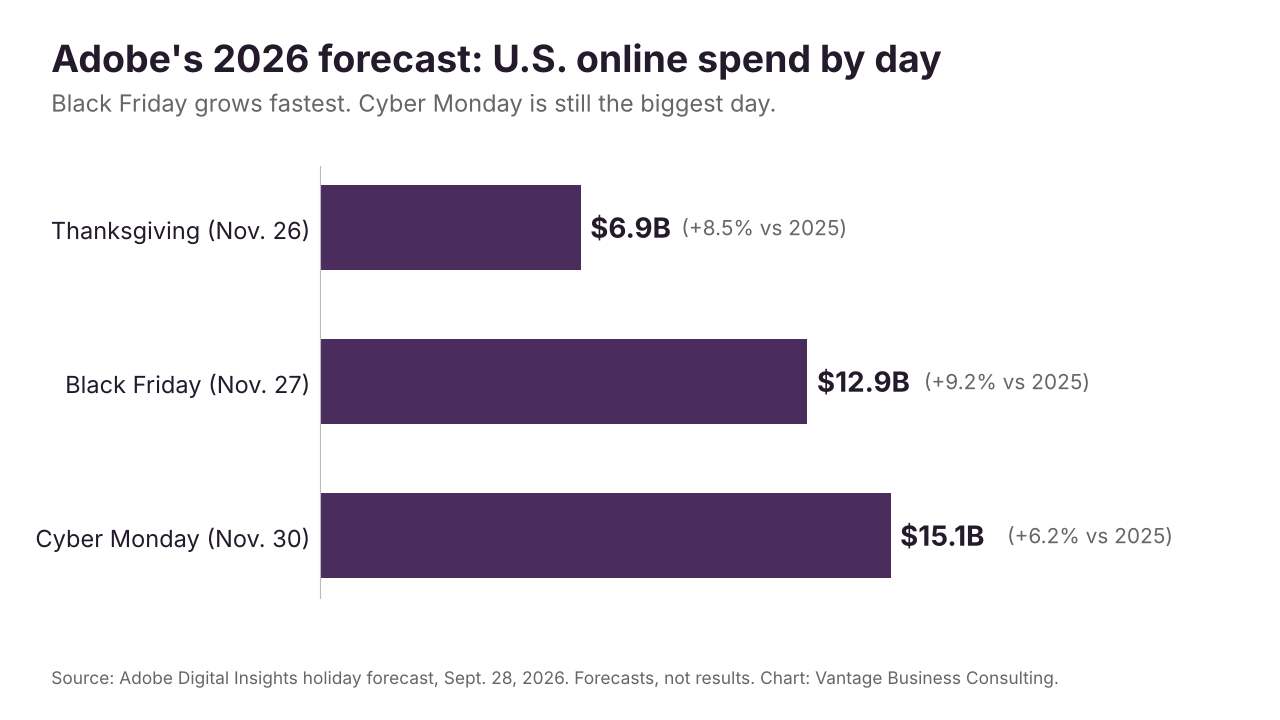
The short answer: Adobe expects U.S. shoppers to spend $47.5 billion online from Thanksgiving through Cyber Monday, up 7.4%, with Black Friday growing faster than Cyber Monday and 63% of spend on phones. Discounts are already as deep as last year, so an established brand wins this week by starting earlier, protecting hero items, fixing mobile checkout and judging the week by margin, not revenue.
Picture a $20 million brand with a Cyber Week plan that fits on one slide: 40% off sitewide on Cyber Monday, a big email push and extra ad spend. It is the same plan as last year, at a deeper discount. The question nobody on the team has asked is whether the money still shows up on Monday, or whether it moved to Friday, to phones and to AI shopping assistants.
At Vantage Business Consulting we work with brands that already sell online and need the holiday to pay for itself, not just post a big number. This is the next post in our Our Read series.
What it means in plain words
Two big forecasts came out this fall. Adobe expects U.S. shoppers to spend $47.5 billion online in the five days from Thanksgiving through Cyber Monday, up 7.4%. Salesforce, which counts a longer week (Tuesday, Nov. 24 through Monday, Nov. 30), expects $84 billion in U.S. online sales, up 6%. Different windows, same direction: a record week, growing a little faster than the season as a whole.
Inside that growth, the shape is changing. Black Friday is growing faster than Cyber Monday. Most of the money is spent on phones. More shoppers arrive from AI assistants. And discounts are as deep as last year, or deeper, while prices per item are flat to down. A record week can still be a weak week for margin.
What the data says
- The season. Adobe’s forecast (Sept. 28, 2026) puts U.S. online spend for Nov. 1 to Dec. 31 at $275.1 billion, up 6.7%. Cyber Week is 17.3% of that.
- By day. Adobe expects Thanksgiving at $6.9 billion (up 8.5%), Black Friday at $12.9 billion (up 9.2%) and Cyber Monday at $15.1 billion (up 6.2%). Cyber Monday is still the biggest day. Black Friday is growing faster.
- Discounts. Adobe expects discounts of up to 30% off listed price during Cyber Week, “on par with the 2025 season.” Salesforce’s Cyber Week forecast (Nov. 19, 2026) says U.S. discount rates in November are 8% higher than last year, while average selling prices for physical goods are down 1% in the U.S.
- Phones. Adobe expects 63% of Cyber Week online spend on mobile, up from 61.6% last year.
- Buy now, pay later. Adobe forecasts $21.3 billion in BNPL spend for November and December, up 6.6%, with $1.09 billion on Cyber Monday alone.
- AI assistants. Adobe expects traffic to U.S. retail sites from AI assistants to rise 130% for the season. Salesforce expects $75.8 billion in global Cyber Week sales, 21% of the total, to be influenced by AI and agents, and says the top use of personal shopping agents is price comparison.
- Waiting. Salesforce says nearly 70% of shoppers are waiting for Cyber Week to make big purchases.
What is thin: these are forecasts, not results. Adobe publishes actuals after the weekend. Both firms build their numbers from retail sites that use their software, so they measure a large slice of online retail, not all of it. They also count different weeks: Adobe and Digital Commerce 360 (Nov. 19, 2026) use the five days from Thanksgiving to Cyber Monday, while Salesforce starts on Tuesday. Two write-ups of the Salesforce release also give slightly different growth figures for October and early November, so we left that number out.
The honest question: should we skip the discount this year?
For most established brands, no. Nearly 70% of shoppers say they are waiting for this week. If you sit it out, many of them buy a competitor’s product on sale instead of yours at full price.
But “take part” does not have to mean “40% off everything.” An illustration, not a real brand: a $40 item with 60% gross margin keeps $24 before marketing and shipping. At 40% off, the price is $24 and the margin is $8. You need to sell three times as many units to keep the same gross profit. At 20% off on a gift set, you need far fewer extra orders to come out ahead. Run that math before you pick the number.
Our read
This section is our opinion.
We read 2026 as the year Cyber Week stopped being a Monday event. If Black Friday is growing faster and more shoppers are comparing prices with AI tools before they buy, the brand that saves its best offer for Monday may find the shopper already bought on Friday. Plan the week as five days with one story, not one day with four days of warm-up.
Depth is the wrong lever to pull harder. Discounts are already at last year’s level or above, and the price per item is slipping. A deeper sitewide cut mostly gives margin to people who would have bought anyway. Gift sets, bundles, a free add-on or a limited holiday item can hit the same price point without resetting your everyday price.
What is overhyped: the idea that AI agents will decide Cyber Week. AI-referred traffic is growing fast from a small base, and Adobe’s 130% is a growth rate, not a share of sales. It matters most for one thing this week: an assistant comparing prices will find your lowest listing anywhere, so a price gap across your accounts is now easy to see. That is a pricing discipline problem more than a technology problem.
What is underrated: the phone checkout. With 63% of spend on mobile and most BNPL on phones, a slow mobile page or a clumsy checkout costs more this week than any discount gains.
What an established brand should do this quarter
- Check your mobile checkout today. Buy your own best seller on a phone, start to finish. Fix anything that takes more than a few taps, and make sure your payment options, including BNPL if you offer it, show up on mobile.
- Move your best offer earlier. Launch on Thanksgiving or Black Friday and hold it through Monday, rather than saving the best deal for Monday alone.
- Set depth by item, not sitewide. Protect hero items. Put the deepest offers on gift sets, bundles and seasonal stock you need to clear before January.
- Line up your price across every channel. If shoppers and AI tools can see every listing side by side, the lowest one sets your price. Our post on protecting your price on Black Friday covers how to keep one account’s deal from breaking it for everyone.
- Read the week by margin, not revenue. On Dec. 1, report gross profit after discounts, shipping and ad spend, and how many buyers were new. Compare it with last year.
- Make your product easy to read for AI tools. Clear product names, sizes, prices and answers to common questions on your pages. Our guide to how CPG brands get found online now walks through the basics.
This is business analysis, not financial advice. Figures are forecasts from Adobe and Salesforce, both of which sell software to retailers. Sources and dates are listed below.
Next step
If your holiday plan has turned into a discount calendar, our post on promotions without the hangover shows how to give every deal a job and an end date. At Vantage Business Consulting, we help established brands build the commercial plan behind the product. If you want a quick read on where your plan has gaps, the free Launch Scorecard below takes about three minutes.
Sources
- Adobe, “Adobe: U.S. Holiday Shopping Season to Hit Record $275.1 Billion Online, Rising 6.7% YoY,” Sept. 28, 2026. news.adobe.com
- Salesforce, Cyber Week 2026 forecast release, Nov. 19, 2026. salesforce.com
- Digital Commerce 360, “3 online sales factors to watch in 2026 holiday shopping forecasts,” Nov. 19, 2026. digitalcommerce360.com