The short answer: In a survey published in JAMA Psychiatry in October, 44.2% of people who drank when they started a GLP-1 said they now drink less, and Circana data shows GLP-1 households spending about 7% less on alcohol. Our read: the alcohol occasion is shrinking, not ending. Win the second drink of the night with the right formats and plain claims, not a GLP-1 label.
At Vantage Business Consulting we work with beverage brands that are already on shelf and defending margin. This is the fifth post in our Our Read series, and it builds on two earlier ones: GLP-1 drugs and the supplement category and non-alcoholic growth.
What it means in plain words
GLP-1 drugs, sold under names you already know for diabetes and weight loss, change appetite. A growing pile of research says they may change the appetite for alcohol too. The newest piece came this month: a Harvard-led survey in which 44.2% of people who drank when they started a GLP-1 said they now drink less.
For a beverage brand, that is not a medical story. It is an occasion story. A guest at a holiday party who used to have three glasses of wine may now have one, then switch. What they switch to, and whose brand is in their hand, is the opportunity. What they stop buying is the risk.
What the data says
Here is what we could verify, with dates. Most of it is survey data, and none of it measures how much less people drink in a way you can put straight into a forecast.
- The new survey. The Harvard Gazette reported on Nov. 2, 2026 on a study published in JAMA Psychiatry in October by researchers from Harvard Medical School, McLean Hospital and RAND, funded by the National Institute on Alcohol Abuse and Alcoholism. Of 2,009 adults surveyed in March and April 2026, 368 reported current or past GLP-1 use, and 242 were drinkers when they began. Of those, 44.2% (106 people) said they drank less, most of the rest reported no change, and three said they drank more. Among users who screened at risk for unhealthy drinking, 54.1% said they drank less.
- Spending, not just intent. BeverageDaily reported on Oct. 23, 2026 that Circana purchase data, as reported by Reuters, showed U.S. households with a GLP-1 user spent around 7% less per month on alcohol than households without one after two years, with beer spending about 13.5% lower. The same piece quotes Heineken saying it sees “some changes in consumption behaviour” among GLP-1 users, while Diageo said any impact “should be manageable.”
- Fewer occasions, not zero occasions. In the U.K., the Morning Advertiser reported on March 31, 2026 on a Drinkaware and KAM study: GLP-1 users drank on 2.2 days a week instead of 3.1, a 29% drop, and spent 30% less on alcohol when out. But 71% said alcohol remains central to their enjoyment of social occasions.
- Where the dollars go. Nutritional Outlook reported on Sept. 10, 2026 on SPINS data showing households with a GLP-1 user cut grocery spending by 6% while buying more protein, fiber, produce and electrolytes, and that growth in active nutrition is coming almost entirely from hydration and creatine.
- How many people. In a KFF poll published Nov. 14, 2025, 12% of U.S. adults said they currently take a GLP-1 drug.
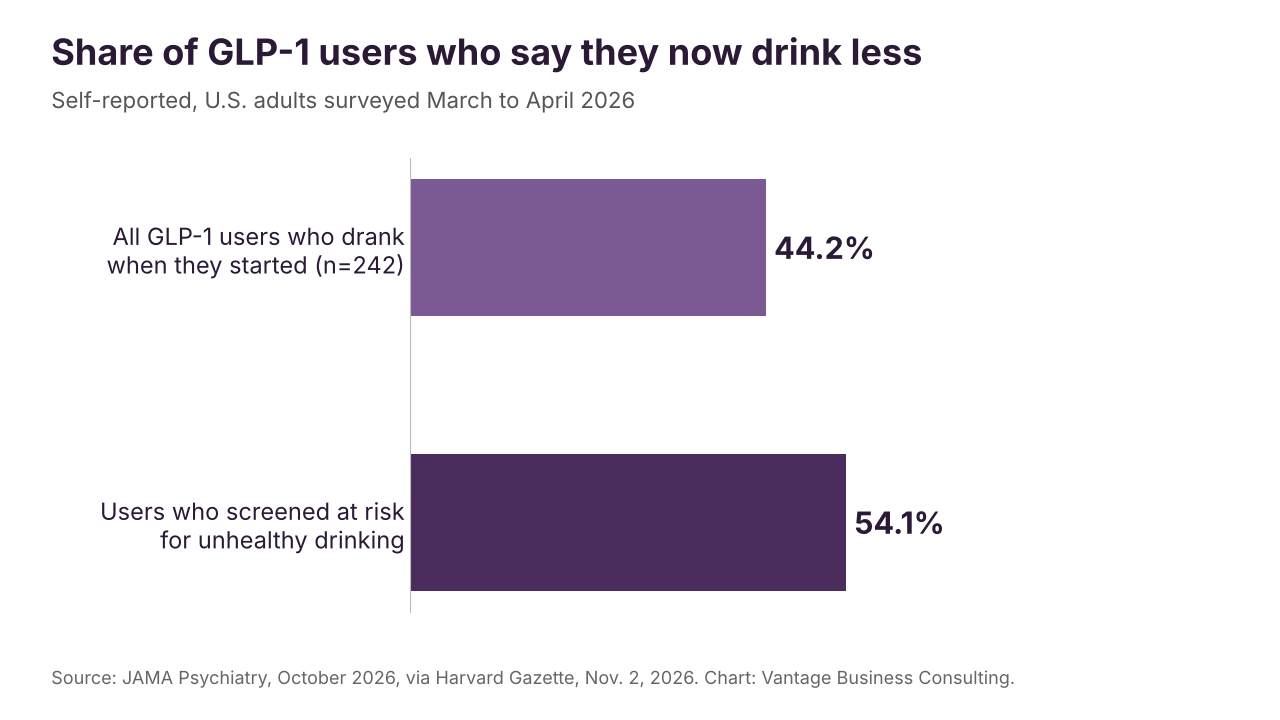
What is thin: the Harvard survey is self-reported, the drinker group is 242 people, and the authors say plainly that it did not measure how much drinking declined. Senior author Haiden Huskamp put it this way: “The evidence isn’t there, but it will be very interesting to watch over the next couple of years.” The U.K. data is a different market. The Circana figure is the strongest U.S. spending signal we found, and we could only read it secondhand.
The honest question: is this a real hit or a headline?
Both, depending on your category. If you sell beer or wine, a 7% to 13.5% lower spend in GLP-1 households is real, and with roughly one in eight adults on these drugs it is already in your numbers, mixed in with every other reason people are drinking less. If you sell non-alcoholic, functional, or hydration drinks, it is a tailwind, but a slow one, and it is not yours by default.
The useful part of the data is the shape. These shoppers are not leaving the party. They are drinking on fewer days and fewer rounds, and the Drinkaware data says most still see drinking as part of the occasion. That leaves a gap in the hand between drink one and going home.
Our read
This section is our opinion.
We read GLP-1s as one more force shrinking the alcohol occasion, not a cliff. Moderation was already happening before these drugs took off; GLP-1s speed it up for a specific, growing group of shoppers. For an alcohol brand, the risk is in volume per occasion, so the defense is premium price per serving and smaller formats, not more promotion.
For non-alcoholic, functional and hydration brands, the opportunity is the second and third drink of the night, not a medical need. Win the occasion: something that looks and feels like a grown-up drink at the party, priced like one.
What is overhyped: “GLP-1 friendly” drinks. We would not build a product or a label around the drug. The audience is a slice of your shoppers, the claim invites regulatory and retailer scrutiny, and the person on a GLP-1 at the party does not want a drink that announces it. We made the same point about supplements in our GLP-1 supplements read.
What an established brand should do this quarter
- Ask your data provider for a GLP-1 cut. Circana, NIQ and SPINS all track GLP-1 households. See whether your buyers over- or under-index before you plan 2027.
- Plan the switch drink for the holidays. Build displays and messaging around the second drink of the night, alongside alcohol rather than against it.
- Rethink pack sizes. Smaller cans and single-serve formats fit a shopper who wants one, not four. Check the per-ounce math so margin survives.
- Keep claims plain. No drug names on pack or in ads. Talk about taste, occasion and ingredients, and have counsel review any hydration or functional wording.
- Watch repeat, not trial. If moderating shoppers try you once and go back to water, the occasion was never yours. Track repeat rate by account monthly.
This is business analysis, not medical or legal advice. Sources and dates are listed below. Several figures are self-reported survey results, and one U.S. spending figure was reported secondhand.
Next step
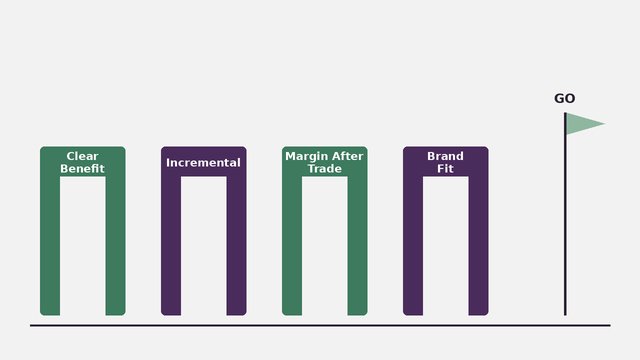
If you are planning a new format or a relaunch for 2027 to catch the moderating shopper, test the idea against the shopper first; our guide to line extensions that start with the shopper shows how. The free Launch Scorecard below takes about three minutes and shows where your plan has gaps.
Sources
- Harvard Gazette, “About half of drinkers on GLP-1s say they imbibed less,” Alvin Powell, Nov. 2, 2026. https://news.harvard.edu/gazette/story/2026/11/about-half-of-drinkers-on-glp-1s-say-they-imbibed-less/
- JAMA Psychiatry, study by Huskamp, Busch and colleagues, October 2026 (as linked by the Harvard Gazette). https://jamanetwork.com/journals/jamapsychiatry/article-abstract/2854926
- BeverageDaily, “GLP-1 drugs put alcohol sales in focus as Heineken warns of impact,” Grace Henry, Oct. 23, 2026. https://www.beveragedaily.com/Article/2026/10/23/glp-1-drugs-raise-questions-over-future-alcohol-sales/
- Morning Advertiser, “Weight loss drugs linked to lower alcohol spend and fewer drinking occasions,” Phoebe Fraser, March 31, 2026. https://www.morningadvertiser.co.uk/Article/2026/03/31/weight-loss-drugs-linked-to-lower-alcohol-spend-and-fewer-pub-visits
- Nutritional Outlook, SPINS data on supplement growth and GLP-1 households, Nicholas Saraceno, Sept. 10, 2026. https://www.nutritionaloutlook.com/view/spins-data-shows-nearly-half-of-supplement-industry-growth-concentrated-two-categories
- KFF Health Tracking Poll, “1 in 8 adults say they are currently taking a GLP-1 drug,” Nov. 14, 2025. https://www.kff.org/public-opinion/poll-1-in-8-adults-say-they-are-currently-taking-a-glp-1-drug-for-weight-loss-diabetes-or-another-condition-even-as-half-say-the-drugs-are-difficult-to-afford/