The short answer: Amazon says FBA fulfillment fees rise an average of $0.19 a unit on Jan. 15, 2027, about 0.8% of the average selling price, and storage fees shift on Feb. 1 to reward inventory that turns in under six months. Our read: the average is not the story. Premium price bands, slow stock and running low cost more, so treat 2027 as an inventory test and price for it now.
At Vantage Business Consulting we work with brands that already sell on Amazon and are defending margin, not chasing a first sale. This is the next post in our Our Read series, and it pairs with today’s pricing post, Tariff Costs Take a Year to Reach the Shelf. Both are about the same thing: costs that land in 2027 and need a plan in 2026.
What it means in plain words
On Nov. 5, Amazon announced its 2027 U.S. fee changes for Fulfillment by Amazon. The headline is small: fulfillment fees rise by $0.19 a unit on average, starting Jan. 15, 2027. Storage fees get rebuilt around how long your inventory sits, starting Feb. 1.
The average hides the real story. Who pays more depends on three things you control: what price band your item sits in, how fast it turns, and how well you manage stock levels. Two brands with the same product can come out of January very differently.
What the data says
Here is what we could verify, with dates. Amazon’s own announcement gives the headline and the storage logic. The detailed rate cards live in Seller Central, which we could not open, so those figures come from two trade write-ups that agree with each other.
- The average. In its Nov. 5, 2026 announcement, Amazon said: “On average, FBA fulfillment fees will increase by $0.19 per unit sold, approximately 0.8% of the average item’s selling price.” Most changes take effect Jan. 15, 2027.
- Storage. In the same announcement, Amazon said the storage utilization surcharge goes away on Feb. 1, 2027, and the aged inventory surcharge is folded into monthly storage fees. Its summary: “flat or lower fees for inventory that turns in under six months, higher fees for aged inventory.”
- The surcharge stays. Amazon said the FBA fuel and logistics surcharge “remains unchanged.” PPC Land (Nov. 6) and EcomCrew (Nov. 5) both put it at 3.5%, in place since April 2026.
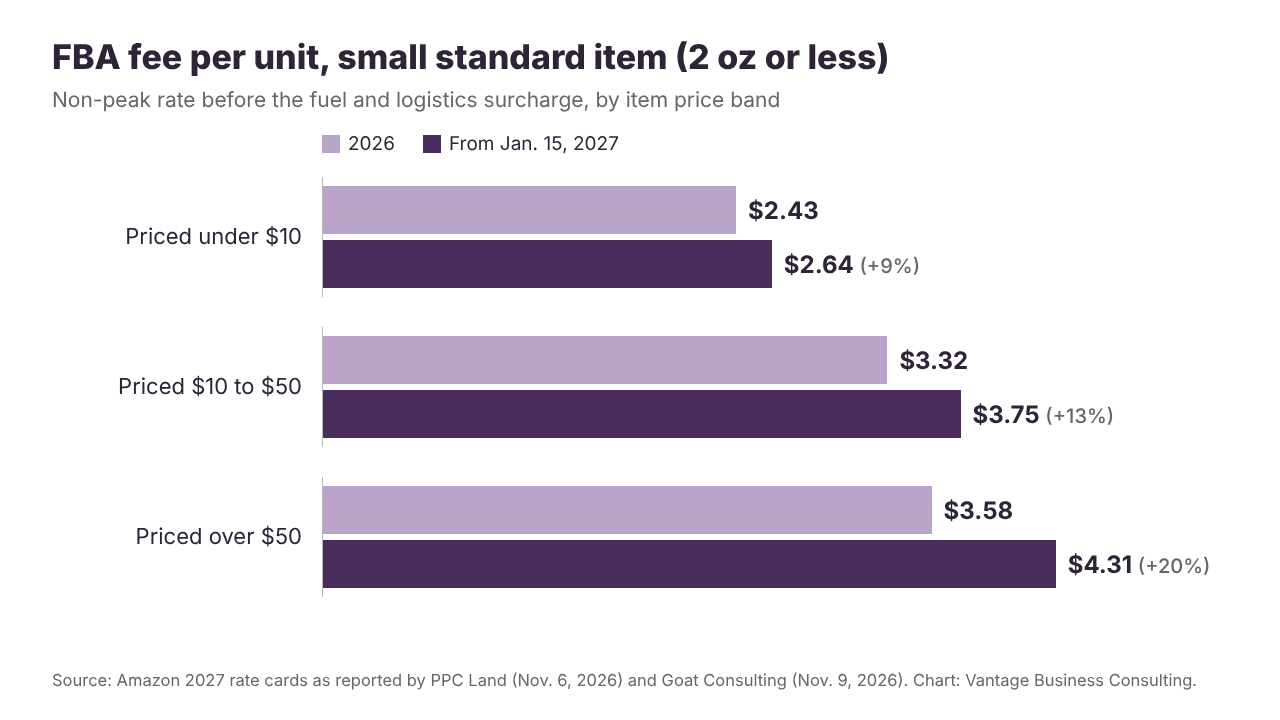
- By price band. PPC Land and Goat Consulting (Nov. 9) report Amazon’s average changes for standard-size items. Small standard: up $0.20 under $10, $0.40 from $10 to $50, and $0.70 over $50. Large standard: unchanged under $10 for non-apparel, up $0.12 from $10 to $50, and $0.47 over $50.
- Low-price categories. Both write-ups say five fee categories lose the lower under-$10 rate on Jan. 15 and pay the $10 to $50 rate instead: Automotive and Powersports, Compact Appliances, Musical Instruments and AV Production, Media, and Computers.
- Running low costs more, too. EcomCrew and Goat report that from Feb. 1 the low-inventory-level fee applies when stock falls below 28 days of supply, measured on shipments in the four weeks before and after the assessment date.
What is thin: we read Amazon’s announcement directly, but not the Seller Central rate tables, so every figure beyond the $0.19 average and the storage summary comes from trade write-ups. The exact age-based storage rates were not in the materials PPC Land reviewed, so we leave them out. Check your own items in Seller Central before you act.
The honest question: is 19 cents worth a meeting?
On revenue, no. On profit, often yes. Amazon puts the average at 0.8% of the selling price. But your profit is not your price.
An illustration, not a real brand: a $25 supplement that keeps $2.50 a unit after cost of goods, Amazon fees and advertising. If its fee rises $0.40, as the $10 to $50 small standard average suggests, that is 16% of the profit on the item, before any storage change. Multiply by a year of units and it is real money.
Our founder directed brand, paid search, SEO and SEM for Vitamin Advisor while its ecommerce sales grew from $1M to $10M. The lesson from that work still holds: on a marketplace, the item that looks fine on revenue can be the one quietly losing money after fees and ads.
Our read
This section is our opinion.
We read 2027 as Amazon pricing for behavior. Amazon says it is adjusting fees “to better match our cost of serving different products,” as PPC Land quotes its letter. In practice, fast-turning inventory that stays in stock is rewarded, and slow, aged stock pays more. The fee change is mostly an inventory management test.
The price bands matter more than the average. In the small standard example above, items over $50 take the biggest jump, about 20%. That hits premium bundles and multi-month supplement packs. If your item sits a little above $50, the fee alone is a reason to look at the price.
What is overhyped: the “19 cents” headline, in both directions. It is not nothing, and it is not a crisis. For most established brands the bigger risk is aged inventory sitting into February and running low enough to trigger the low-inventory fee, at the same time.
What an established brand should do this quarter
- Run every ASIN through Amazon’s own tools. PPC Land and Goat say Amazon added a fee change comparison view in its profit analytics and updated the Revenue Calculator. Sort your items by new fee as a share of contribution margin, not of price.
- Check your price band edges. Per both write-ups, an item at exactly $10.00 or $50.00 pays the $10 to $50 rate. Look at every item priced just over $50, and every item near $10 in the five categories that lose the low-price rate.
- Clear aged inventory before Feb. 1. Decide now what to sell through, bundle, remove or liquidate, so you do not carry old stock into the new age-based storage fees.
- Plan inbound for steady supply. Aim to stay above 28 days of supply without overstocking. Tighter forecasts by item will matter more in 2027 than in any year before.
- Confirm your size tier. Check that the dimensions and weight Amazon has on file match your real package. A wrong measurement can put an item in a more expensive tier.
- Put the fee change in your 2027 price plan. Do not treat it separately from tariffs and supplier increases. Price once, with every cost on the page.
This is business analysis, not legal or financial advice. Sources and dates are listed below. Detailed rate card figures are as reported by trade publications and should be checked in Seller Central.
Next step
If your 2027 plan includes a price change, a new bundle or a move into retail alongside Amazon, see how we think about the order of channels in Channel Sequencing: Why DTC-First Is Not Always the Smart Path to Retail. The free Launch Scorecard below takes about three minutes and shows where your plan has gaps.
Sources
- Amazon Selling Partners, “Update to US referral and Fulfillment by Amazon fees for 2027,” Sunny Jain, Vice President, Worldwide Fulfillment by Amazon, Nov. 5, 2026. https://sellingpartners.aboutamazon.com/update-to-us-referral-and-fulfillment-by-amazon-fees-for-2027
- PPC Land, “Amazon sellers face average $0.19 FBA fee rise from January 15, 2027,” Nov. 6, 2026. https://ppc.land/amazon-sellers-face-average-0-19-fba-fee-rise-from-january-15-2027/
- EcomCrew, “Amazon’s 2027 Fee Math Doesn’t Stop at 19 Cents,” Nov. 5, 2026. https://www.ecomcrew.com/amazons-2027-fee-math-doesnt-stop-at-19-cents/
- Goat Consulting, “2027 Amazon FBA Fee Changes and Full FBA Rate Card,” Nov. 9, 2026. https://www.goatconsulting.com/amazon-fulfillment/amazon-fba-fee-changes-for-2027