The short answer: On Dec. 11, 2026, a federal law takes effect that caps hemp-derived products at 0.4 milligrams of total THC per container, which puts nearly every hemp THC drink on the market outside the legal definition of hemp. Congress delayed it once, from Nov. 12, and a new Senate bill would replace the ban with rules, but nothing has passed. Our read: plan for the ban, hope for the fix, and protect the rest of your business from the inventory and retailer fallout.
At Vantage Business Consulting we work with established beverage brands, including brands in the non-alcoholic and functional sets where hemp THC drinks have been sitting. This is the next post in our Our Read series for beverage brands, after non-alcoholic growth and GLP-1 drinkers drinking less. Hemp THC drinks were one of the fastest growing answers to both trends. In about three weeks, most of them lose their federal legal footing.
What it means in plain words
In November 2025, the law that ended the government shutdown also rewrote the federal definition of hemp. As law firm Troutman Pepper Locke summarized it (Dec. 10, 2025), three changes matter for drinks:
- Total THC counts. The 0.3% limit now covers total THC, including THCA, not just delta-9.
- A per-container cap. A finished hemp-derived cannabinoid product with more than 0.4 mg of total THC per container is excluded. For a drink, the container is the can or bottle sold at retail.
- No synthesized cannabinoids. Cannabinoids the plant does not make naturally, or that were made outside the plant, are out.
The original effective date was Nov. 12, 2026. Then H.R. 6500, a stopgap funding law signed Sept. 2, moved most of the change to Dec. 11, 2026, per Akerman (Sept. 2) and Foley Hoag (Sept. 15). Cannabinoids the plant cannot produce naturally lost hemp status on the original date.
What happens after Dec. 11? Legal commentary, including OFW Law (Nov. 5), says products over the cap stop being hemp and fall under federal marijuana law. None of the commentary we read describes a federal grace period or sell-through window. How hard federal agencies will enforce is an open question.
What the data says
The category is real money, though the estimates vary widely depending on who is counting:
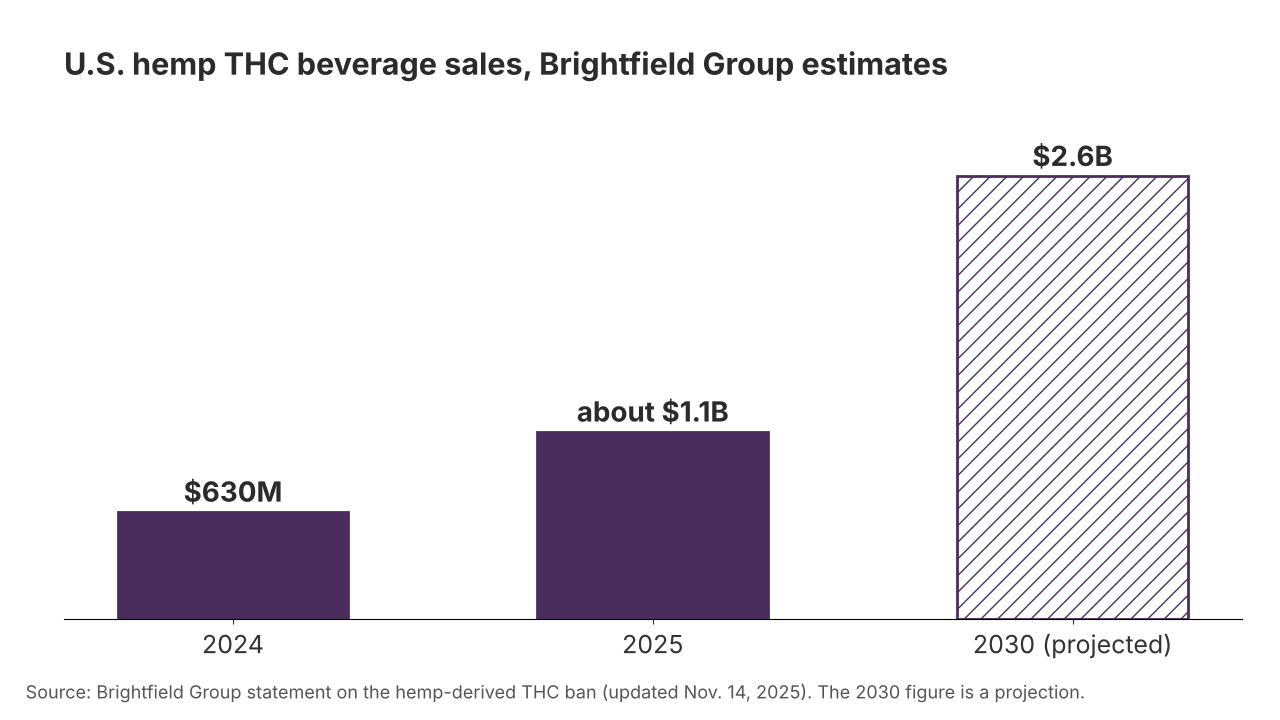
- Brightfield Group, a cannabis market research firm, puts U.S. hemp THC beverage sales at $630 million in 2024 and nearly $1.1 billion in 2025, and projected $2.6 billion by 2030.
- NielsenIQ, as reported by TheStreet (Nov. 16), tracked $200.5 million in retail sales for the 52 weeks ended Jan. 3, 2026, up 134%. That counts only the stores Nielsen tracks.
- Whitney Economics, in a 2026 report published by an industry campaign, estimates hemp beverages at $2.94 billion to $3.77 billion and projects up to 225,861 lost jobs across all hemp cannabinoid products. That is an industry-financed estimate built on survey projections.
Where things stand this week:
- A rescue bill. Sens. Tim Sheehy and Amy Klobuchar introduced the Hemp Guardrails Act on Nov. 17, which would stop the ban and set rules instead, including a 21 and older age limit, per Cannabis Business Times (Nov. 18).
- Opposition. Sens. Ted Budd and Pete Ricketts say they will oppose any year-end funding package that delays the ban or builds a regulatory framework, per Marijuana Moment (Nov. 18), which also lists several House bills, including one to regulate the drinks like alcohol.
- States are not waiting. Illinois began enforcing a 0.4 mg cap on Nov. 12, with stronger products limited to licensed dispensaries, and Missouri’s new law took effect the same day, per Business of Cannabis (Nov. 13).
- Retailers are moving. Binny’s in Illinois stopped selling hemp THC drinks on Nov. 12, per TheStreet. Total Wine is lobbying for a bill that would put the drinks under federal alcohol regulators with a per-serving limit, per The Marijuana Herald (Nov. 4).
What is thin: we could not open the statute text on congress.gov, so the definitions above come from law firm summaries. The market numbers come from research firms and an industry campaign, and they disagree by billions.
The honest question: will Congress fix it in time?
Maybe. Dec. 11 is also when the current stopgap funding runs out, so the next funding bill is the obvious place for a delay or a new framework. There is real support for rules over a ban, from both parties and from big alcohol retailers. There is also organized opposition in the Senate, and three weeks is not long.
The cost of guessing wrong is lopsided. If you plan for the ban and Congress delays it, you lose a few weeks of sales. If you plan for a delay and the ban lands, you are holding inventory you may not legally be able to sell.
Our read
This section is our opinion.
Plan for Dec. 11 as real. Congress already moved the date once, and it could again, but a plan built on a vote that has not happened is not a plan.
The long-term direction looks like rules, not zero. Most of the bills on the table, and the retailers lobbying for them, point toward an adult-only, alcohol-style category with clear dose limits. If that is where it lands, the winners will be brands that already know how to sell through alcohol distributors and licensed retail, with compliant labels and age checks.
What is overhyped: two stories. “THC drinks are replacing alcohol” ran ahead of the numbers: even the most generous estimate above is a few billion dollars, a niche next to the alcohol aisle. And “the category is dead” ignores how much pressure there is for a regulated version. The near term is messy. The end state is still open.
For non-alcoholic and functional brands without THC, this is a shelf story. When a retailer pulls a row of THC cans from the cooler, that space goes to someone. Our post on keeping your shelf when retailers cut SKUs covers how buyers decide.
What an established brand should do this quarter
- Count every unit over the cap. By SKU and by location: your warehouse, distributors, retailers and DTC. Stop or pause production of anything over 0.4 mg per container that cannot sell through by Dec. 11.
- Settle returns and markdowns with retailers in writing. Who owns unsold product on Dec. 12? Get the answer now, not in a deduction on a January remittance.
- Get state-by-state legal advice. Some states route stronger products to licensed dispensaries, others ban them outright. Know where any of your products can still be sold legally, and under what license.
- Decide on a compliant or THC-free version. If the brand has real loyalty, test whether a version at or under the cap, or a functional drink without THC, keeps the buyer. Do it as a test, not a bet-the-company launch.
- Protect the rest of the business. Check with your insurer, payment processor and distributors so a THC line does not put your other products at risk.
- Write two plans and watch the funding bill. One for the ban on Dec. 11, one for a delay or a framework. Decide in advance what you will do in the first week under each.
This is business analysis, not legal advice. Talk to counsel about your products and states. Sources and dates are listed below.
Next step
Whether you sell hemp THC drinks or the non-alcoholic drinks next to them, 2027 shelf plans are being set now. See how we think about the order of channels in Channel Sequencing: Why DTC-First Is Not Always the Smart Path to Retail. The free Launch Scorecard below takes about three minutes and shows where your plan has gaps.
Sources
- Troutman Pepper Locke, “Congress Narrows Federal Definition of Hemp, Effectively Banning Most Intoxicating Hemp Products,” Dec. 10, 2025. https://www.regulatoryoversight.com/2025/12/congress-narrows-federal-definition-of-hemp-effectively-banning-most-intoxicating-hemp-products/
- Akerman, “Congress Approves One-Month Delay of Federal Hemp THC Restrictions,” Sept. 2, 2026. https://www.akerman.com/en/perspectives/congress-approves-one-month-delay-of-federal-hemp-thc-restrictions.html
- Foley Hoag, “A Temporary Reprieve for Hemp THC Products, but What Now?” Sept. 15, 2026. https://foleyhoag.com/news-and-insights/blogs/cannabis-and-the-law/2026/september/a-temporary-reprieve-for-hemp-thc-products%E2%80%A6-but-what-now/
- OFW Law, “Federal Hemp Ban,” Nov. 5, 2026. https://ofwlaw.com/federal-hemp-ban/
- Brightfield Group, “Brightfield Statement on Hemp-Derived THC Ban,” updated Nov. 14, 2025. https://blog.brightfieldgroup.com/brightfield-statement-on-hemp-derived-thc-ban
- TheStreet, “Popular THC drinks are disappearing from retail store shelves,” Nov. 16, 2026. https://www.thestreet.com/retail/popular-thc-drinks-are-disappearing-from-retail-store-shelves
- Whitney Economics, 2026 U.S. Hemp Cannabinoid Report (industry-financed). https://www.saveourrelief.org/reports/whitney-economics-2026-us-hemp-cannabinoid-report.pdf
- Cannabis Business Times, “U.S. Senators Finalize Plan to Rescue Hemp Products From Ban,” Nov. 18, 2026. https://www.cannabisbusinesstimes.com/hemp/news/16541927/us-senators-finalize-plan-to-rescue-hemp-products-from-ban
- Marijuana Moment, “GOP Senators Say They’ll Try to Block Any Government Funding Bill That Keeps Hemp THC Products Legal,” Nov. 18, 2026. https://www.marijuanamoment.net/gop-senators-say-theyll-try-to-block-any-government-funding-bill-that-keeps-hemp-thc-products-legal
- Business of Cannabis, “Hemp Enforcement Spreads to the States,” Nov. 13, 2026. https://businessofcannabis.com/cannabis-news-today-friday-13-november-2026-hemp-enforcement-spreads-to-the-states-as-auxly-posts-record-quarter/
- The Marijuana Herald, “Total Wine Expands Federal Hemp THC Lobbying Effort as December 11 Deadline Approaches,” Nov. 4, 2026. https://themarijuanaherald.com/2026/11/total-wine-expands-federal-hemp-thc-lobbying-effort-as-december-11-deadline-approaches/